
Water systems
Local chlorine production for rural and small-town drinking-water networks.
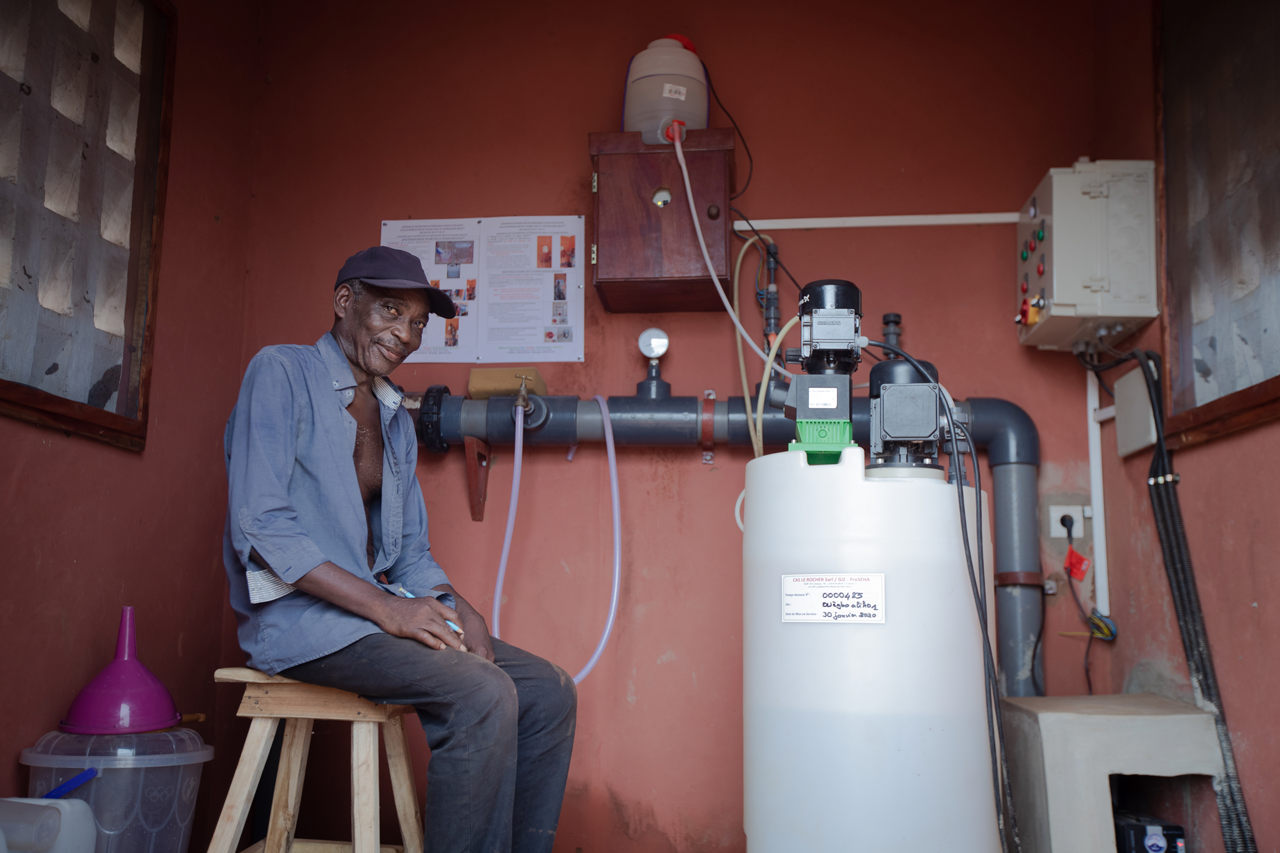
- Batch or continuous production at the network
- Storage, dosing and injection at the reservoir
- Autonomous operation, solar compatible
Produce chlorine where you need it.
Produce sodium hypochlorite locally to help control waterborne pathogens and support safe water and hygiene — in healthcare facilities, water treatment and humanitarian operations.
The challenge
1 in 4
people globally still lack access to safely managed drinking water.
1.7 billion
people still drink water contaminated with faecal matter.
Safe water and effective hygiene depend on reliable disinfection — wherever it is needed.
Sources: WHO / UNICEF Joint Monitoring Programme · WHO Drinking-water
The technology
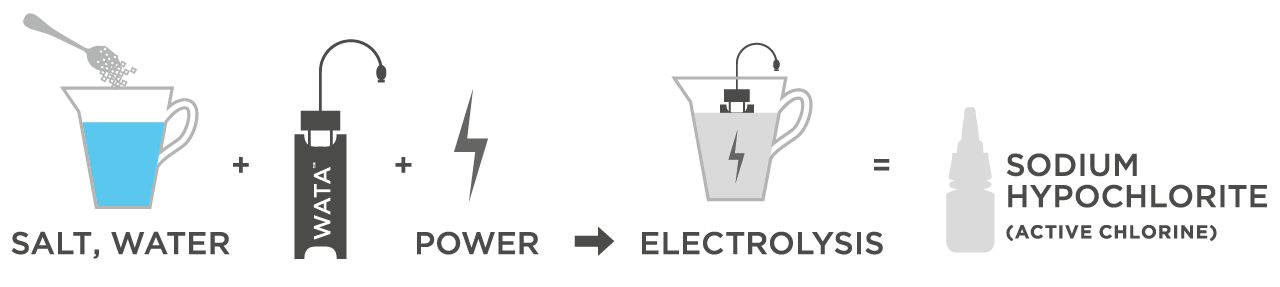
WATA produces sodium hypochlorite locally through the electrolysis of salt water. No chlorine shipment, no chemical stock to import — production happens at the point of use.
Applications
Local chlorine production for rural and small-town drinking-water networks.
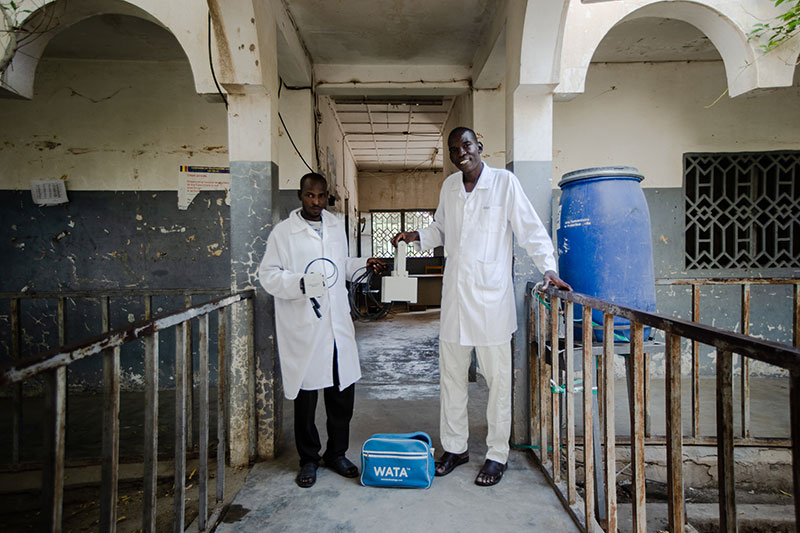
On-site chlorine and disinfectant production where supply chains are unreliable.
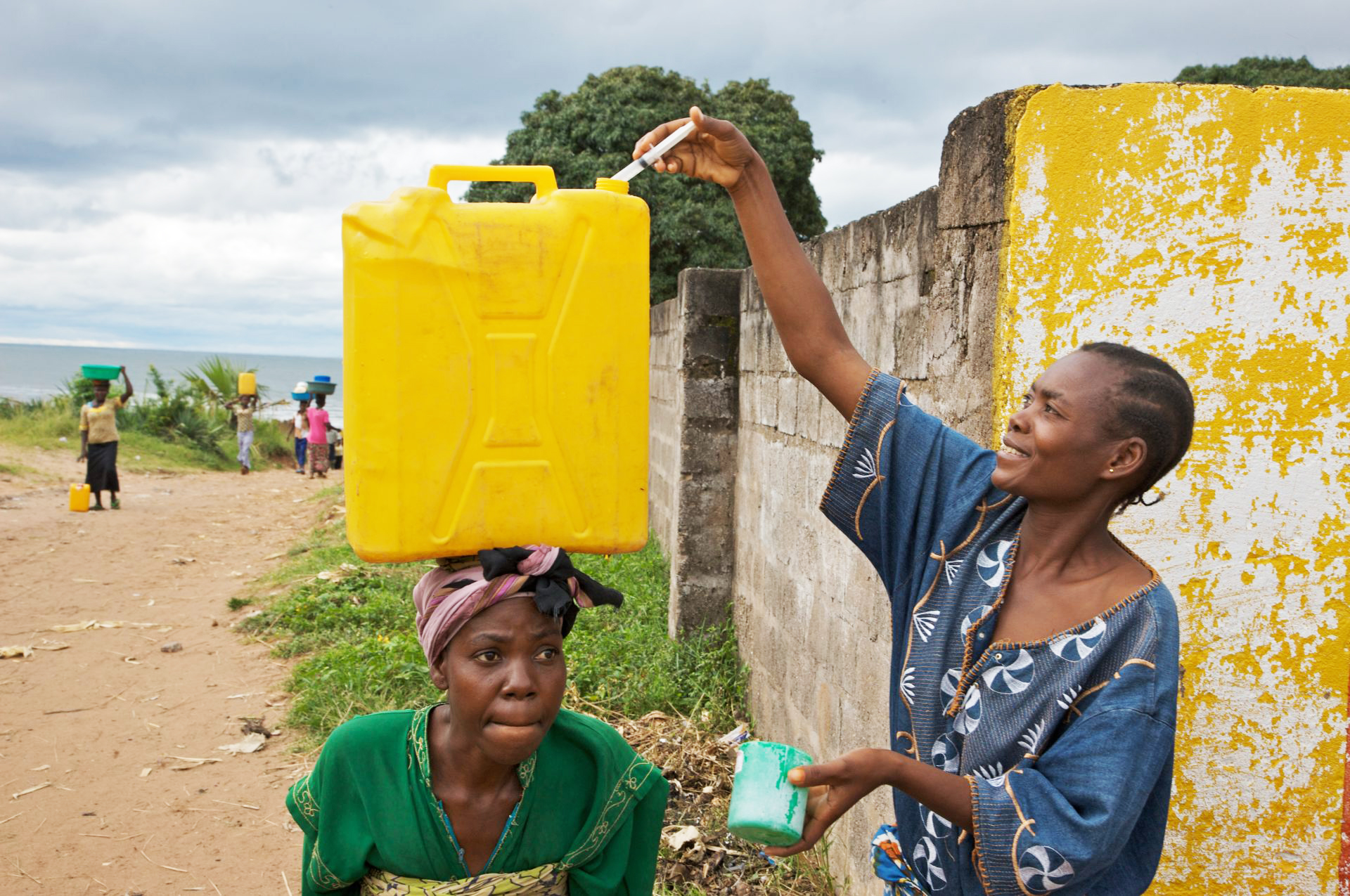
Portable, robust chlorine production for emergencies and difficult logistics.
Why local production
Produce chlorine where it is needed, without relying on regular chemical deliveries or distant suppliers.
Use salt, water and electricity to reduce recurring chemical procurement, transport and storage costs.
Produce fresh sodium hypochlorite on site at a controlled concentration, instead of relying on chlorine that may degrade during storage and transport.
Simple inputs, straightforward operation and the possibility to work with grid, battery or solar power depending on the WATA configuration.
Less to transport. Less to throw away.
Local production can reduce recurring chemical transport and packaging waste, helping lower the environmental footprint of chlorination.
Product family
Four scales of the same principle. Batch volume and chlorine output increase; operation stays the same.
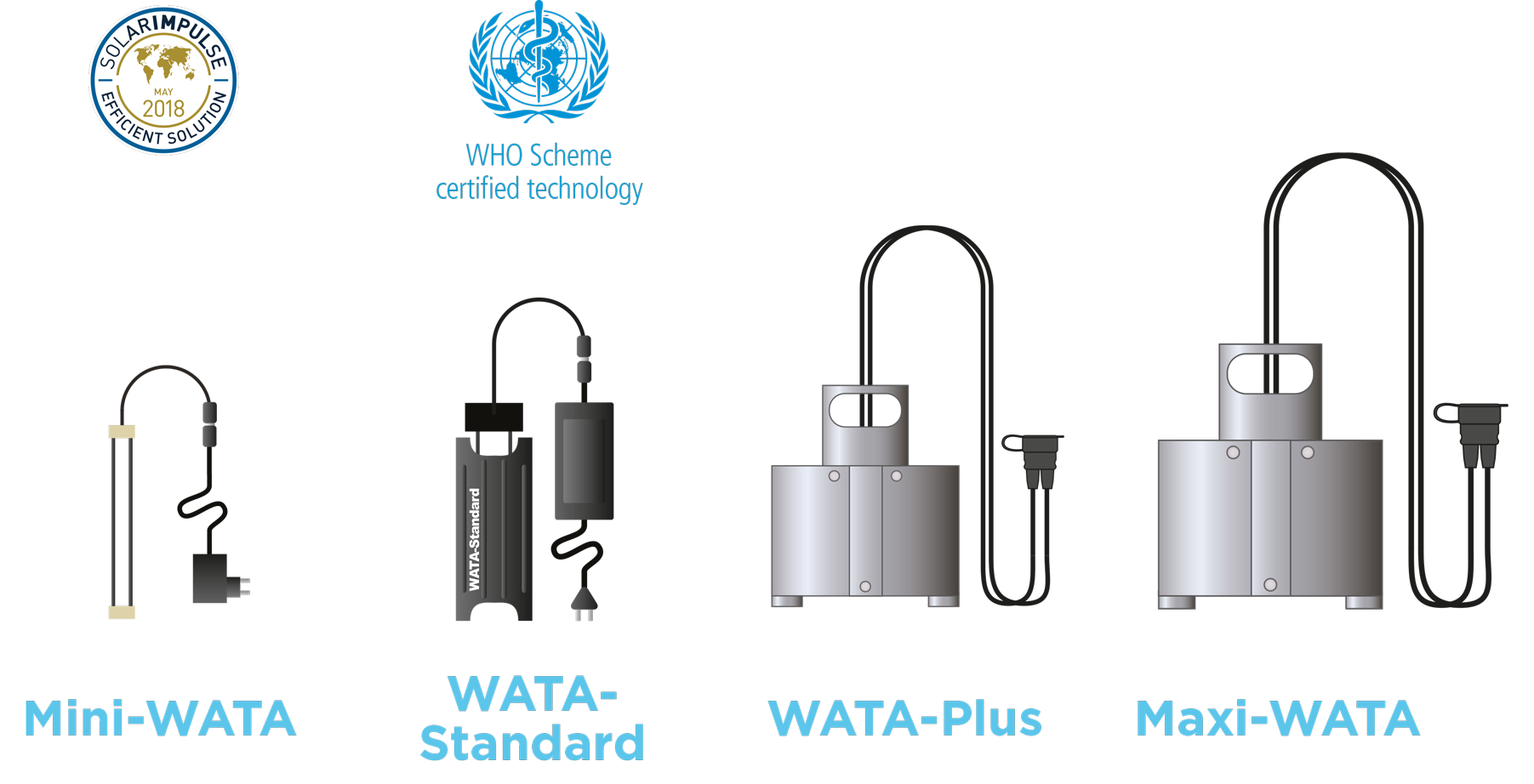
Mini-WATA
WATA-Standard
WATA-Plus
Maxi-WATA
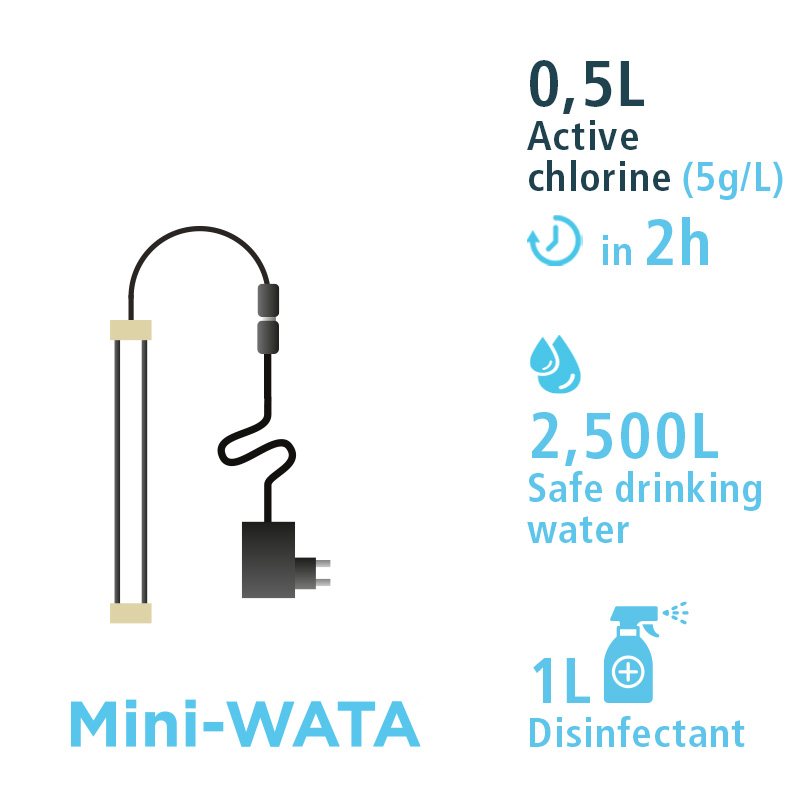
2,500 L · Water treated / batch*
Small scale
Households, small health posts, training and demonstration
Specifications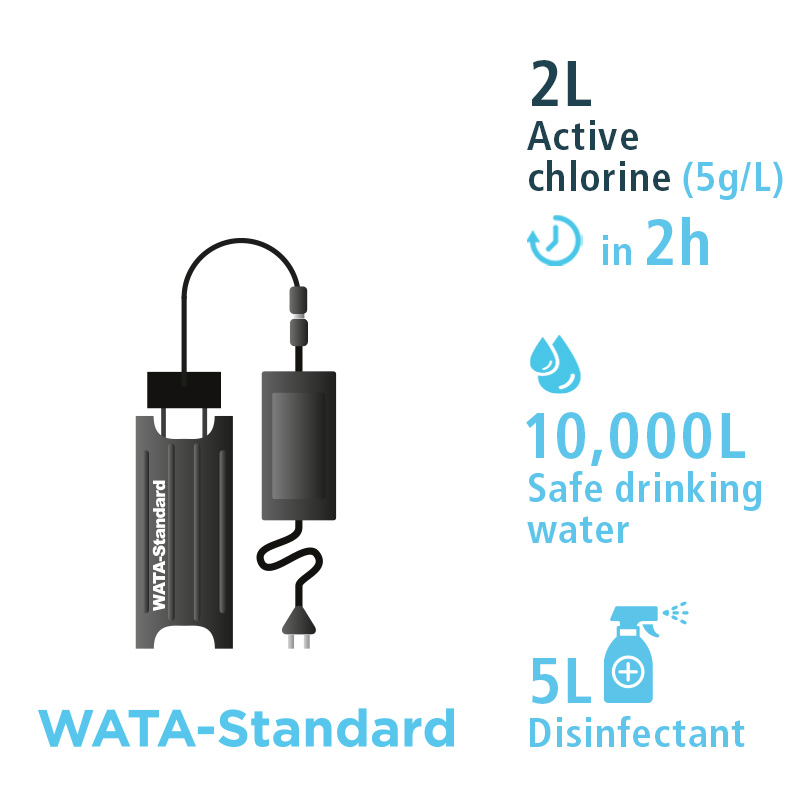
10,000 L · Water treated / batch*
Facility scale
Health centres, small institutions, point-of-use chlorination
Specifications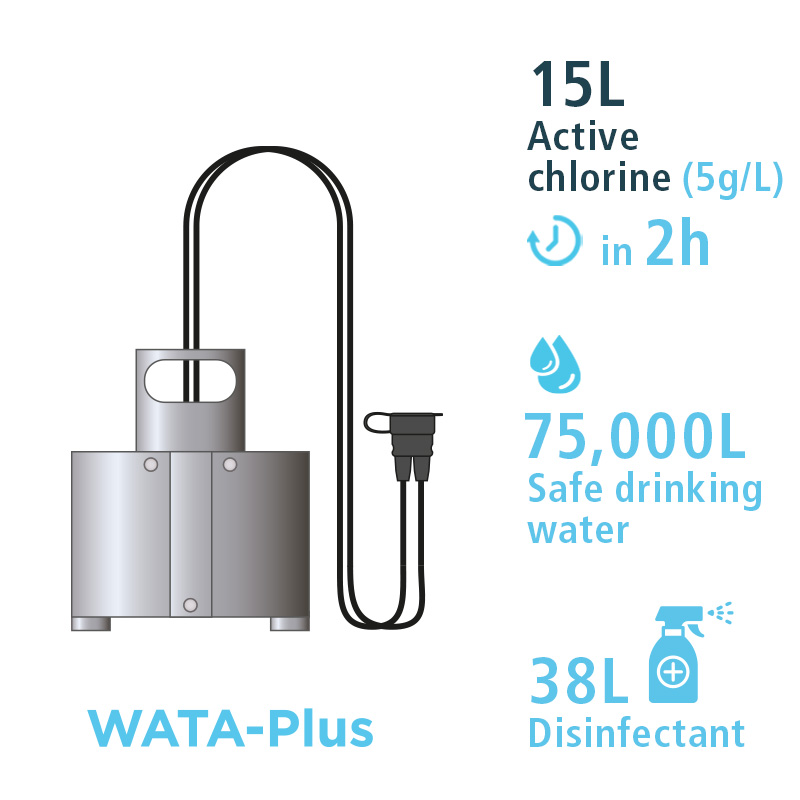
75,000 L · Water treated / batch*
Institutional scale
Hospitals, humanitarian operations, small water systems
Specifications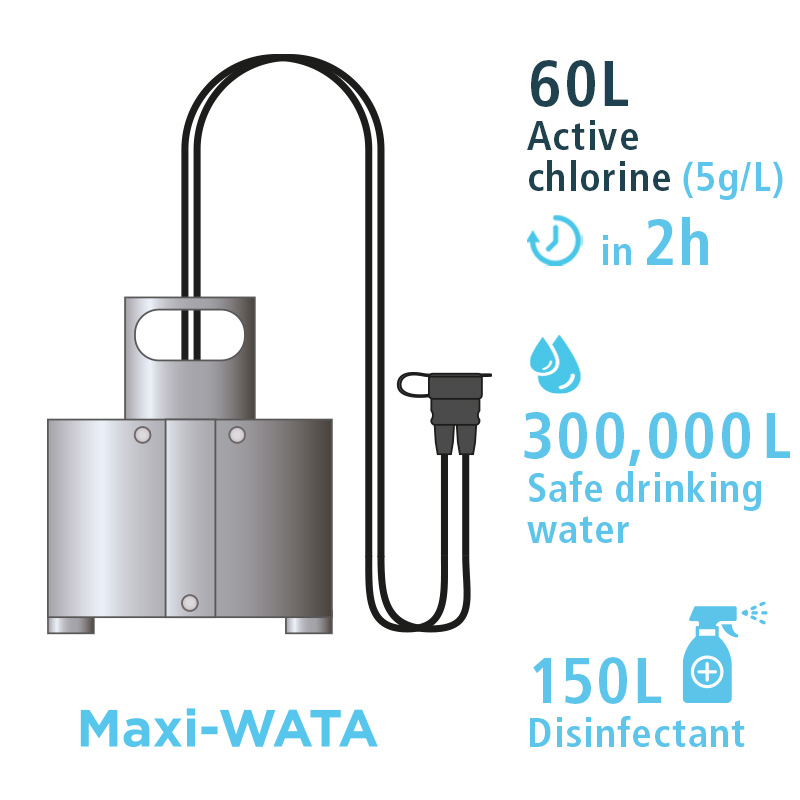
300,000 L · Water treated / batch*
Network scale
Rural and small-town drinking-water networks
Specifications*Water treatment capacity calculated using a reference chlorine dose of 1 g/m³. Actual chlorine demand and treatment capacity depend on raw water quality, operating conditions and the required residual chlorine level.
Daily production figures are based on 4 production cycles of 2 hours per day.
| Specification | Mini-WATA | WATA-Standard | WATA-Plus | Maxi-WATA |
|---|---|---|---|---|
| Batch volume | 0.5 L | 2 L | 15 L | 60 L |
| Chlorine concentration | 5 g/L | 5 g/L | 5 g/L | 5 g/L |
| Active chlorine per batch | 2.5 g | 10 g | 75 g | 300 g |
| Production cycle | 2 h | 2 h | 2 h | 2 h |
| Daily active chlorine production (4 cycles) | 10 g/day | 40 g/day | 300 g/day | 1.2 kg/day |
| Water treated per batch* | 2,500 L | 10,000 L | 75,000 L | 300,000 L |
| Daily water treatment capacity (4 cycles)* | 10 m³/day | 40 m³/day | 300 m³/day | 1,200 m³/day |
| Electrical requirements | 10 W | 36 W | 216 W | 888 W |
| Solar compatibility | Solar kit available | Solar kit available | Solar kit available | Designed on demand |
| Kit dimensions & weight | 39 × 17 × 12 cm · 0.8 kg | 34 × 25 × 23 cm · 2.4 kg | 50 × 26 × 34 cm · 6.7 kg | 50 × 26 × 34 cm · 8 kg |
| Typical applications | Households, small health posts, training and demonstration | Health centres, small institutions, point-of-use chlorination | Hospitals, humanitarian operations, small water systems | Rural and small-town drinking-water networks |
*Water treatment capacity calculated using a reference chlorine dose of 1 g/m³. Actual chlorine demand and treatment capacity depend on raw water quality, operating conditions and the required residual chlorine level.
Daily production figures are based on 4 production cycles of 2 hours per day.
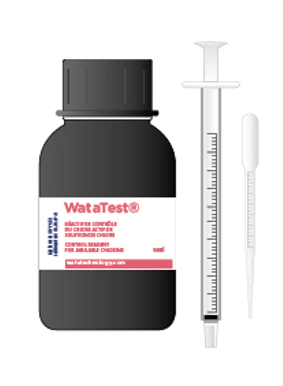
Control reagent for available chlorine — verifies the concentration of the solution produced.
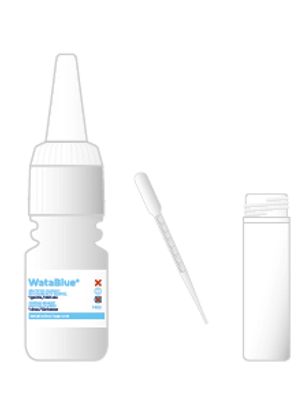
Reagent used to check residual chlorine in treated water.
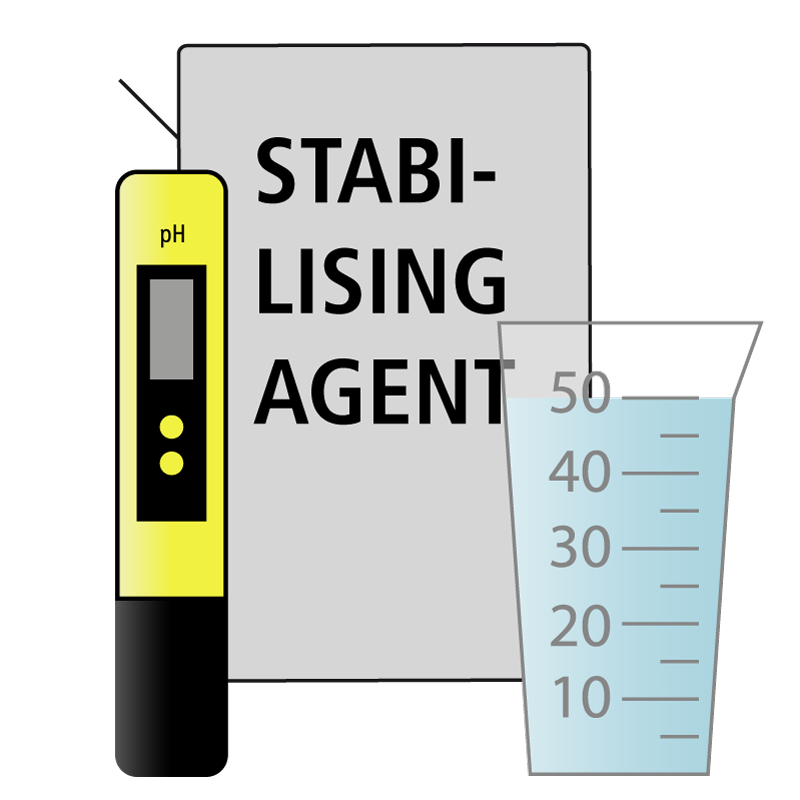
Stabiliser extending the shelf life of the produced hypochlorite solution.
Sizing assistant
Answer what you know. We estimate the daily chlorine demand and suggest a starting configuration.
Daily chlorine requirement [g/day] = daily water consumption [m³/day] × dose [mg/L]
Example: 150 × 1.5 = 225 g/day
WATA · Step 1 of 8
Volume of water to be chlorinated each day.
Energy autonomy
From ready-to-use solar modules to custom-designed systems, WATALUX provides the power solutions to produce chlorine where reliable electricity is not available.
Plug & play
Complete, compact and preconfigured solar modules for Mini-WATA to WATA-Plus.
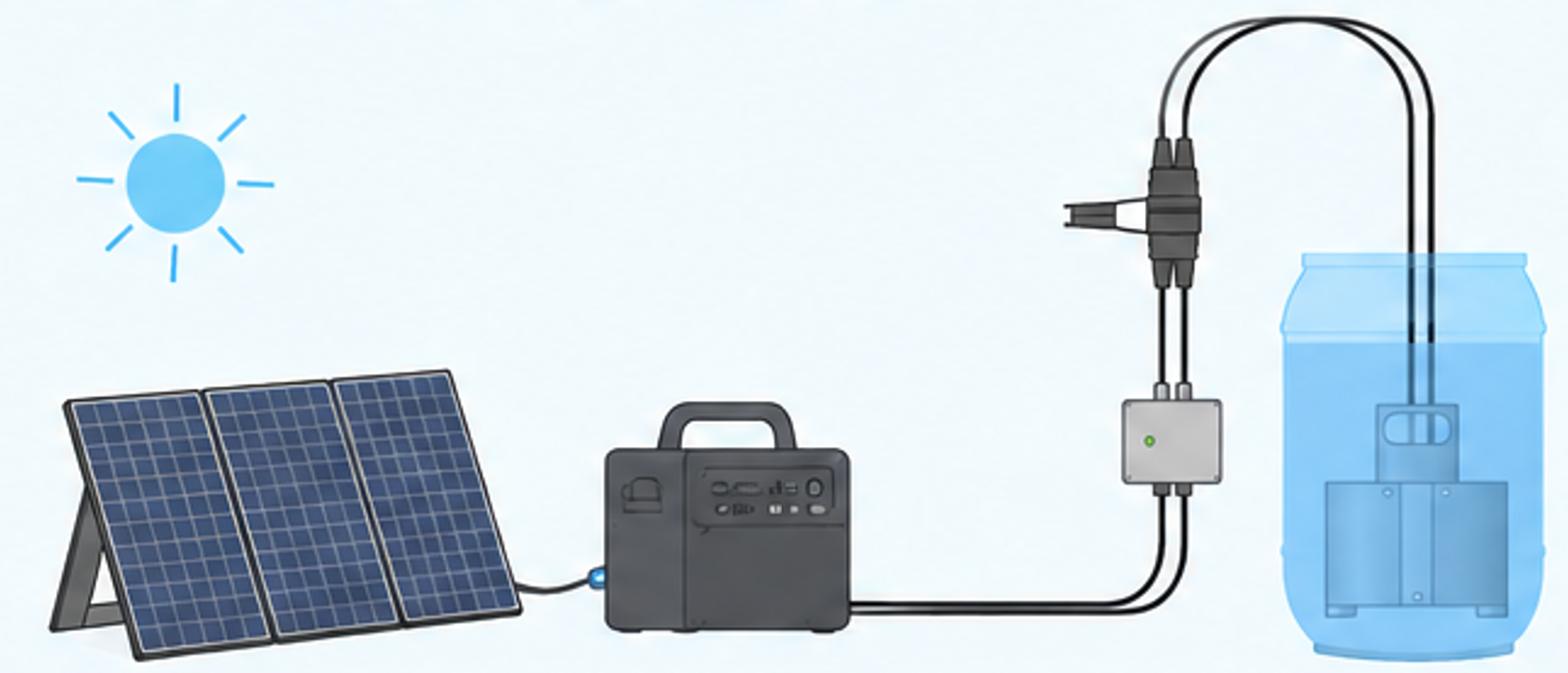
Solar module
Power unit (battery + control)
Connection
WATA in tank (chlorine production)
Mini-WATA | WATA-Standard | WATA-Plus
Custom design
On request, we design complete solar power systems for Maxi-WATA and specific installations.
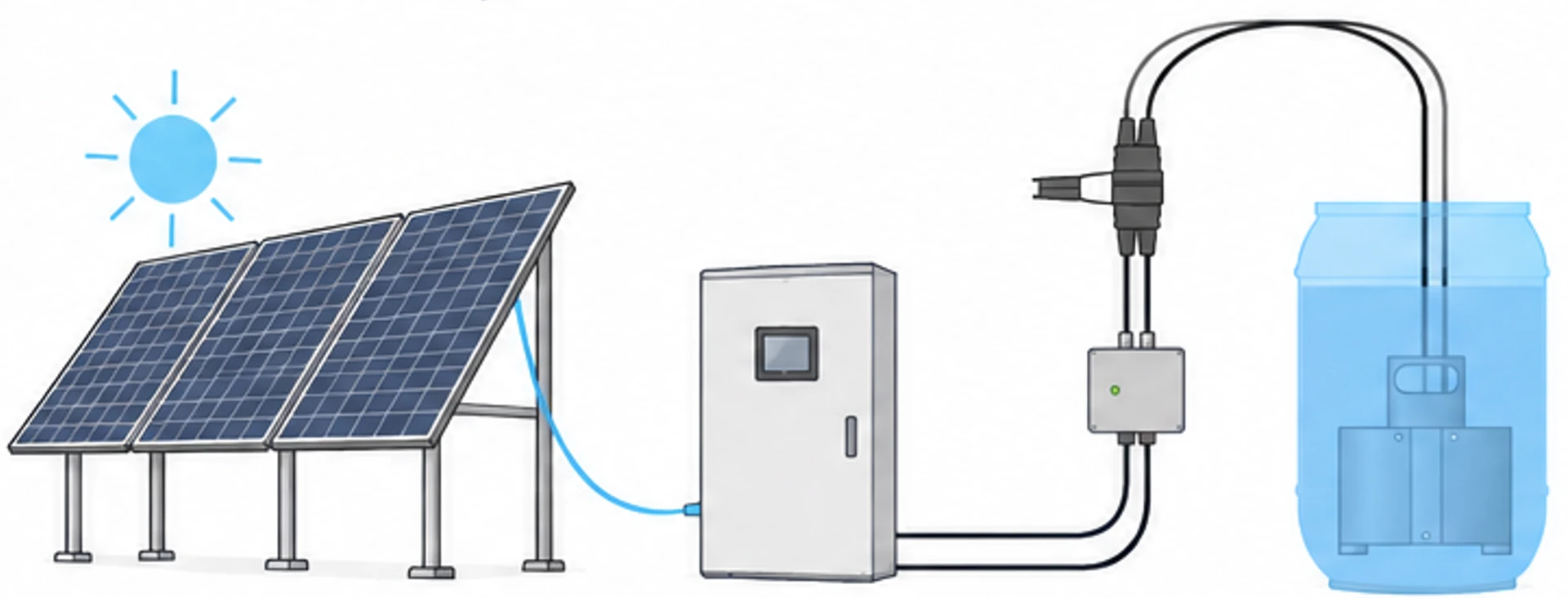
Solar array
Energy management & storage
Connection
WATA in tank (chlorine production)
Maxi-WATA | Custom configurations
Complete chlorination system
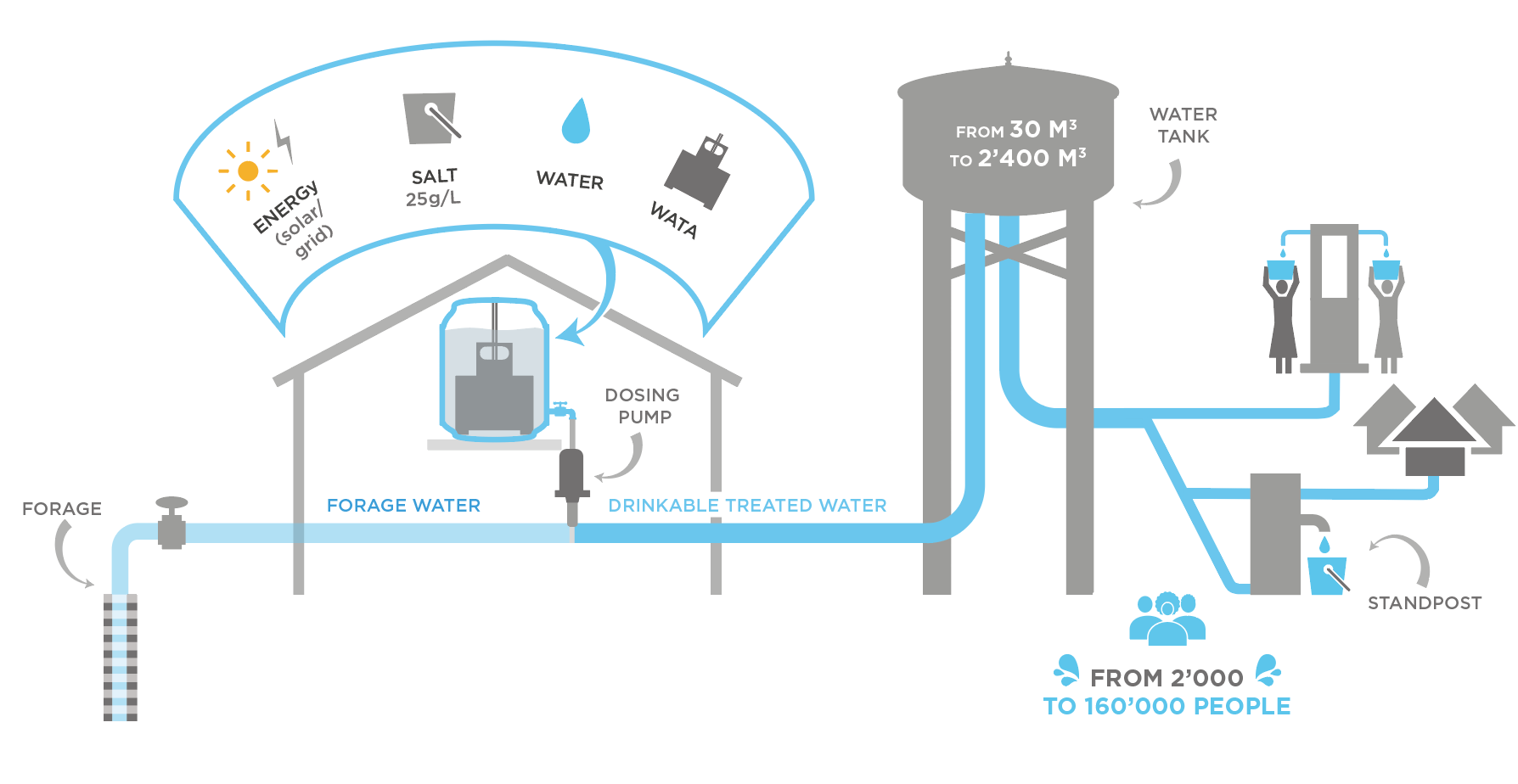
WATALUX supports the full path from water source to treated water: production, energy, storage, dosing, injection, measurement and operator knowledge.
Field experience
Verified WATA deployments, documented project by project. New field records are added as they are validated.
Deployment record
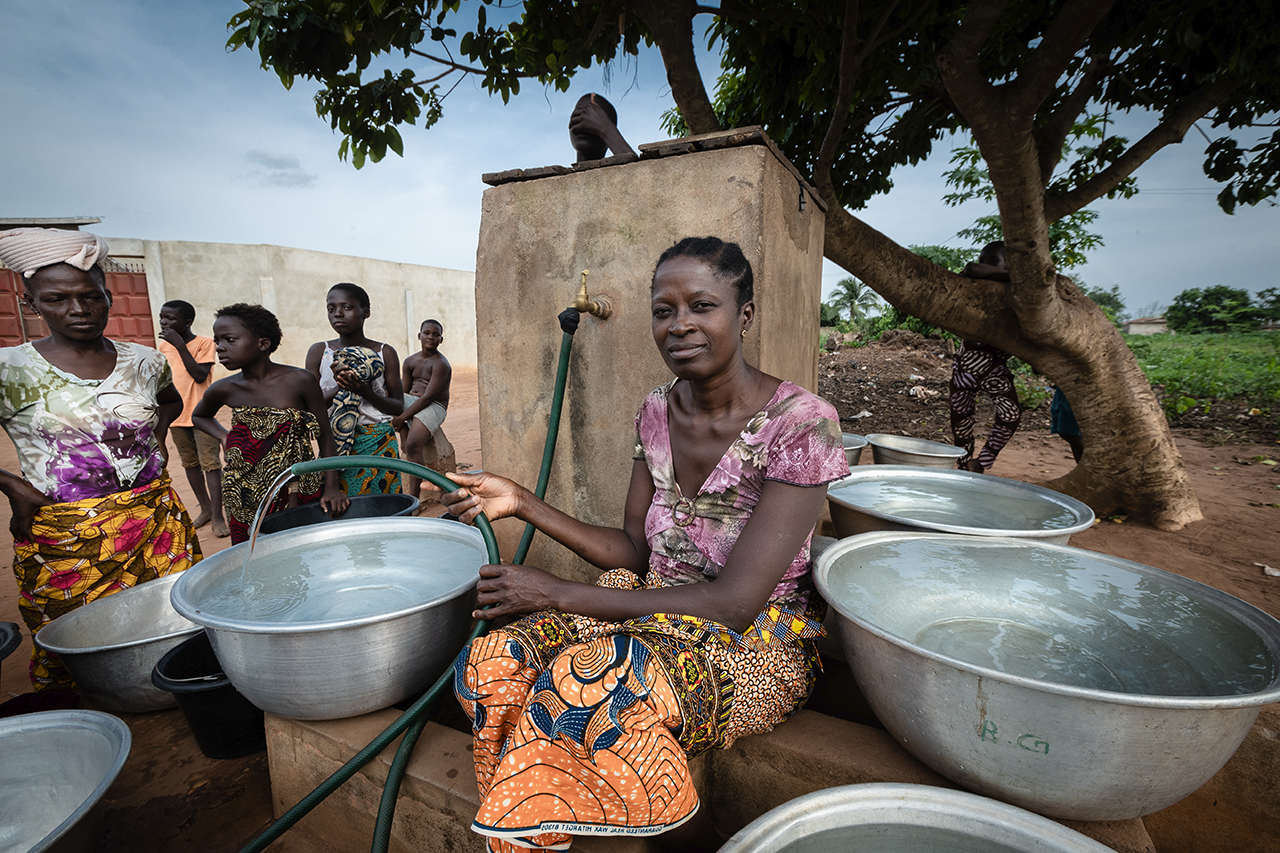
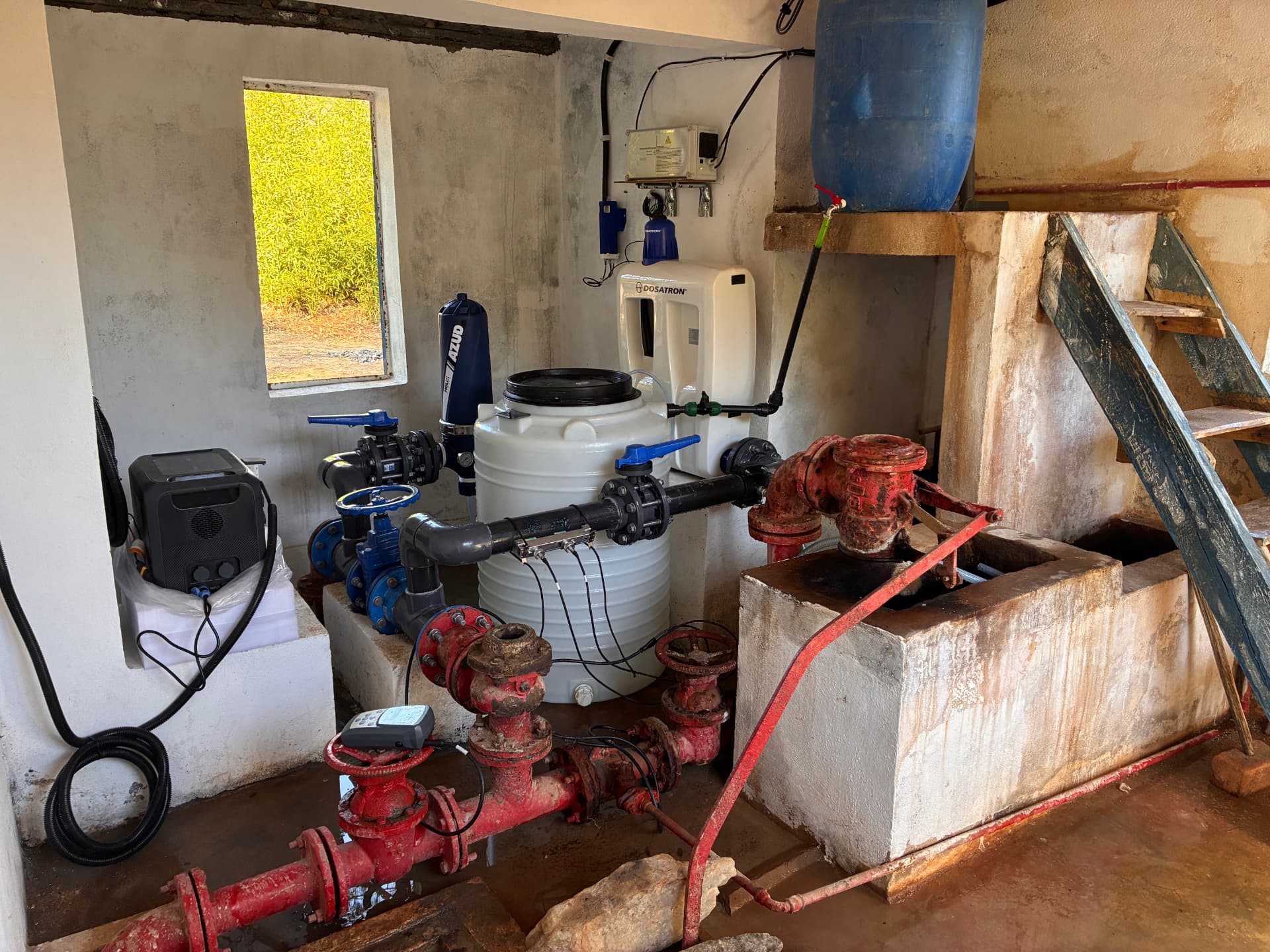
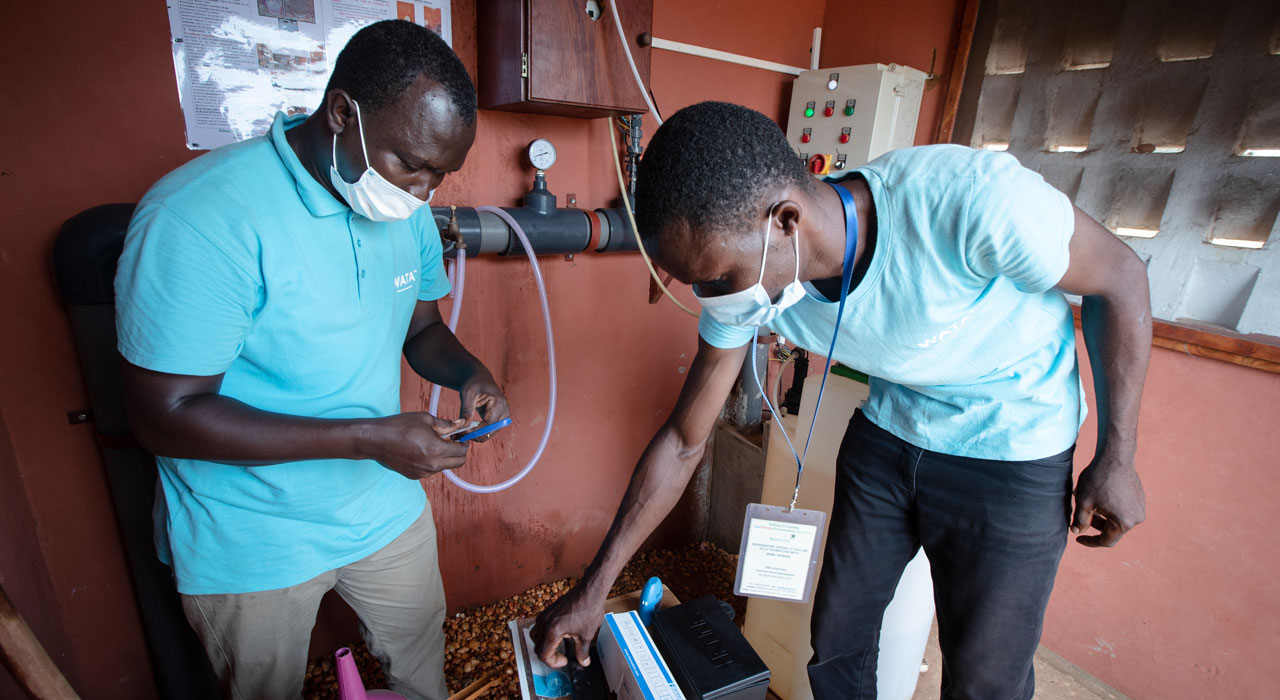
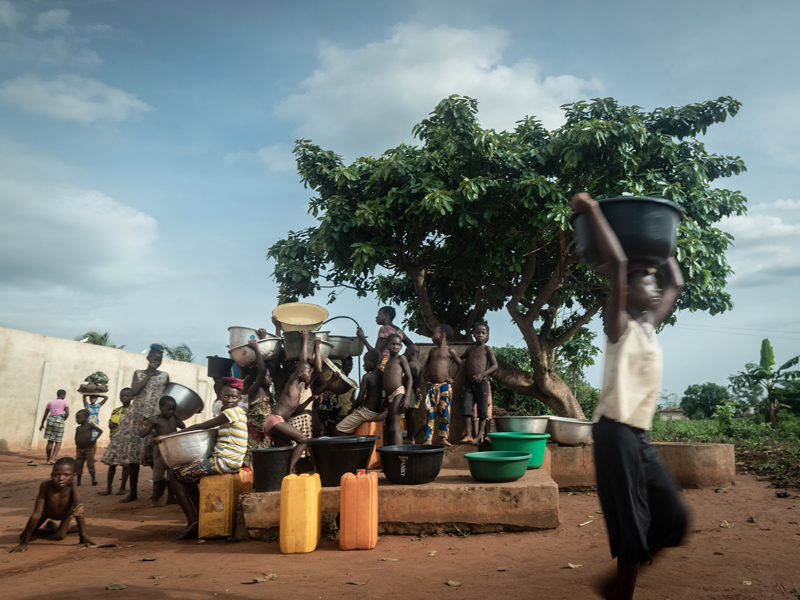
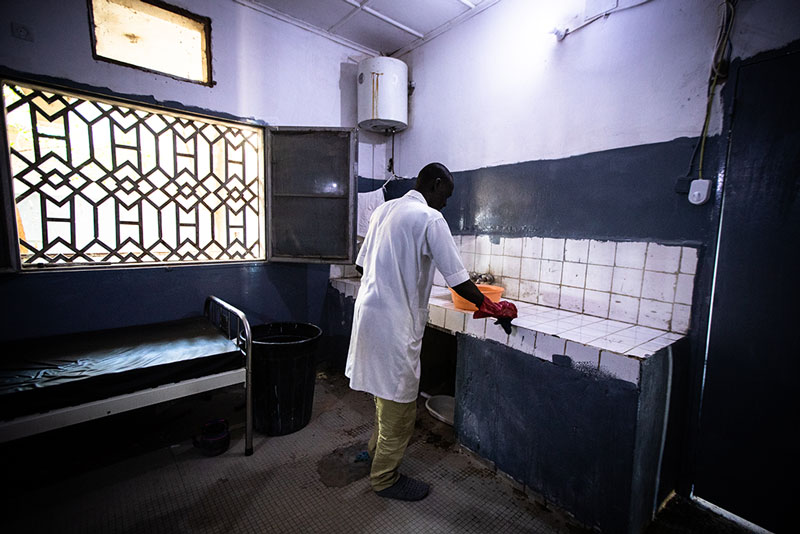
With the Directorate General for Water, GIZ rehabilitated village water supply systems across Benin with small treatment plants: borehole water is pumped, chlorinated and distributed through village standpipes. WATA devices let operators produce liquid chlorine on site, and a dosing pump injects the active chlorine directly into the network. After a first phase equipping 31 rural water supplies at the end of 2020, the programme scaled in 2021 with 25 additional water supplies and 69 health centres equipped with WATA for water and surface disinfection. Implementation: Burex-3eA and WATALUX SA.
A selection of humanitarian, health and development organizations using WATA solutions worldwide.






…and many more organizations and local partners worldwide.
About WATALUX
WATALUX is the Geneva-based team behind WATA technology. We bring together engineering, water and humanitarian field experience to develop practical chlorine-production systems for demanding environments.
We stay closely involved from technical assessment and system design to installation, training and field support, working alongside customers and local partners.
Meet the team and discover our storyContact
Have a project, a technical question or want to learn more about WATA? Our team is here to help.